


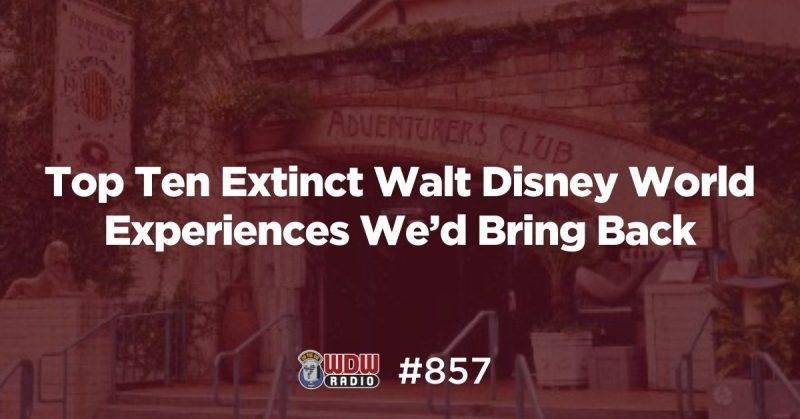
Extinct Walt Disney World Things We’d Bring Back Tomorrow (And the Memories They Left Behind)
There are moments at Walt Disney World that you did not plan for, did not pay extra for, and did not even realize were special until years after they were gone. Not rides. Not shows. Something smaller. The way a cast member looked you in the eye before stamping your hand. The sound of a radio station welcoming you onto property before your parents parked the car. The feel of a paper FastPass ticket in your pocket that you could hand to a stranger. These extinct and discontinued Walt Disney World experiences shaped how the place felt in ways that efficiency and technology have not fully replaced.
In this episode of WDW Radio, Lou Mongello and longtime friend Tim Foster, publisher of Celebrations Magazine and Celebrations Press, sit down for an unscripted, unprepared walk through the extinct and discontinued moments at Walt Disney World that they would revive without hesitation. There are no attractions on this list. Just the human, nostalgic, sometimes forgotten details that defined what made Walt Disney World feel like more than a theme park.
Episode Snapshot
- Lou Mongello and Tim Foster share their personal top 10 lists of extinct and discontinued Walt Disney World experiences, with no prep and no spoilers for each other.
- The conversation covers the Adventurers Club, Disney’s Magical Express, paper FastPass tickets, the Walt Disney World AM radio station, Streetmosphere performers, the Fiesta Fun Center, Dream Finder as a walk-around character, CommuniCore, and much more.
- Both lists are different, proving that what makes Disney feel personal varies from guest to guest.
- Tim Foster discusses his new Spaceship Earth book and the growing Celebrations Press library of Disney deep-dive titles.
- Lou and Tim close with an invitation for listeners to share their own lists in the WDW Radio Clubhouse or by calling the voicemail.
What You Will Discover in This Episode
- Why paper FastPass tickets created a kind of guest-to-guest magic that no digital system has replicated
- What made the Adventurers Club the most immersive theatrical experience Walt Disney World ever produced
- How Disney’s Magical Express extended the Disney bubble all the way to the airport gate
- The story behind the Walt Disney World AM radio station and the ritual of arrival it created for generations of car-trip families
- Why the Lights of Winter in Epcot were unlike any holiday experience in the parks
- What the France Pavilion’s hidden library contained and why it felt like a secret only you knew about
- How Streetmosphere performers on Main Street USA and Hollywood Boulevard made those streets feel genuinely alive
- Why CommuniCore was Epcot doing exactly what Epcot was born to do
- The resort experiences, childcare centers, arcade memories, and food favorites that round out both lists
Timestamps
- 0:00 – Introduction: the little things that made Disney feel different
- 2:36 – Welcoming back Tim Foster, publisher of Celebrations Magazine
- 4:10 – Nearly 100 top 10 episodes together, with no preparation either time
- 7:50 – Tim’s #1: paper FastPass tickets and paying it forward to strangers
- 11:20 – Lou on paper FastPass: free, tactile, communal, and a lost gift
- 14:10 – Lou’s #1: The Adventurers Club at Pleasure Island
- 18:07 – Congaloosh: the legacy of the Adventurers Club fan community
- 20:38 – Tim: Lights of Winter at Epcot during the holidays
- 24:37 – Lou: Streetmosphere performers on Main Street USA and Hollywood Boulevard
- 30:16 – Tim: the hidden library in the France Pavilion at Epcot
- 33:36 – Lou: the Walt Disney World AM radio station (AM 1030)
- 39:33 – Tim: the Fountain of Nations and the Electric Umbrella at Epcot
- 42:34 – Lou: Disney’s Magical Express
- 49:52 – Tim and Lou: the Contemporary’s fourth floor, Fiesta Fun Center, and Polynesian lobby
- 54:15 – Honorable mentions: Shrunken Ned’s Junior Jungle Boats, Disney Quest, Cubs Den and resort childcare centers, fiber optic ground lights at Epcot, Main Street Bakery
- 58:02 – Lou: hand stamps for re-entry, the Dream Squad, House of Magic, original Penny Arcade, Dream Finder as a walk-around character
- 1:05:02 – CommuniCore and what Epcot was born to do
- 1:08:45 – Tim’s late addition: Imageworks
- 1:09:24 – Closing reflections and invitation to share your list
- 1:11:43 – Tim Foster on Celebrations Press: Spaceship Earth book, It’s a Small World book, and the spring issue of Celebrations Magazine
Full Episode Summary
Lou opens the episode in a mood he describes honestly: nostalgic, sentimental, and genuinely curious about which memories he has shared with his listeners and which ones only he carries. The premise is simple and intentionally broad. No attractions. No ticket prices. Just the extinct and discontinued Walt Disney World things that changed how the place felt. And to do this right, he calls in Tim Foster, whose friendship with Lou stretches back nearly 20 years and whose work at Celebrations Magazine and Celebrations Press reflects the same deep reverence for Disney history and story.
Neither man prepares a list in advance. That is by design. The unprepared format has been a WDW Radio signature for close to 100 top 10 episodes, and it produces exactly what you hear here: genuine surprise, overlapping enthusiasm, and the occasional moment where one of them says “that was on my list too” at the exact same moment.
Tim opens with paper FastPass tickets, not out of nostalgia for the system itself, but for the specific moment it made possible: holding a paper ticket at the end of the day, realizing you are not going to use it, and handing it to a stranger who had just missed out. That act of spontaneous generosity, Tim explains, was a kind of cast-member-adjacent magic that guests could create for each other. Lou follows with his own love of the physical and communal nature of paper FastPass: no app required, no 7 a.m. alarm, just a walk to a kiosk and a small piece of paper that told you to come back between 2:15 and 3:15. It was free. It was tactile. And it was, in Lou’s words, almost a little thank-you built into the system.
Lou’s first selection is the Adventurers Club at Pleasure Island, and his voice shifts when he gets there. The Adventurers Club was a fully immersive theatrical experience built around an elaborate fictional mythology: eccentric explorers, big game hunters, world travelers, and a two-story building where the masks on the walls talked back. Equity performers improvised across multiple rooms so that no two visits were the same. There was no merchandise, no food service, no real monetization beyond the gate ticket to Pleasure Island itself. And that may have been part of why it went away. But it remains, for many Disney fans, the finest piece of immersive entertainment the company ever produced in a park. Lou closes his memory of the Adventurers Club with one word: congaloosh.
Tim’s second selection is the Lights of Winter at Epcot: a series of synchronized light arches that lined the promenade between Future World and World Showcase during the Christmas season. For guests arriving on the monorail, catching the light show mid-transit was one of the most unexpectedly magical holiday moments in the parks. The lights disappeared without announcement or explanation, and Tim believes they may still be stored somewhere on property. Lou admits he spent one November waiting for construction to begin on a modernized replacement that never came.
Lou then covers Streetmosphere performers on Main Street USA and at Hollywood Studios, doubling up his answer in classic Tim Foster style. These were improv actors in period costume woven into the streets themselves: townspeople on Main Street, gossip columnists and talent scouts and pushy directors on Hollywood Boulevard. They made both streets feel populated and alive. They also served an operational function, absorbing crowd flow in ways guests never noticed. Their absence, Lou says, makes both streets feel like beautiful but uninhabited sets.
Tim’s hidden gem pick is the small library tucked behind the Perfume Shop in the France Pavilion at Epcot. It was not a store, not a restaurant, not an attraction. It was simply a room filled with details: a stained glass Beauty and the Beast window, a rose on the mantelpiece, original storybook editions of classic fairy tales, hidden Mickeys throughout. Tim describes the feeling of bringing someone there for the first time and watching their reaction. That experience, the ability to gift someone a secret discovery, is one of the things that made World Showcase feel endlessly deep.
Lou’s AM 1030 segment may be the most personal of the episode. As he drove onto Walt Disney World property as a child, there was a moment where the car radio could be tuned to AM 1030 and Disney would begin speaking to the family directly: park hours, wait times, weather, dining tips, the resorts. A human voice, already welcoming you, before the car was even parked. Lou describes the image of his brother and himself leaning toward the front seat of a station wagon, parents on either side, all of them listening together. It was ambient storytelling, he says. It was emotional arrival before physical arrival. And it was the kind of shared, analog, human moment that a smartphone app simply does not replicate.
Disney’s Magical Express earns its place on Lou’s list for the same psychological reason: the moment your feet touched the ground at Orlando International Airport, the Disney bubble began. A cast member in a distinctive uniform, waving Mickey hands, greeted you at baggage claim. You boarded a Disney bus. Your checked luggage was pulled from the carousel and delivered to your room while you were in the parks. You never touched a bag. You never called a car. Disney had you from the gate all the way to your resort room. Tim’s version of this memory is the long walk through the airport toward the Magical Express boarding area, seeing it from a distance, recognizing the Disney colors, and feeling the shift begin.
Tim’s resort memories include the fourth floor of the Contemporary, when the grand concourse corridor was a peaceful open gathering space, and the Concourse Steakhouse, home of Super Waiter Dan and the legendary double-cream-spinach moment. He also mourns the original Polynesian lobby fountain, which he associates with the 1970s in the best possible way, musty water smell included. Lou stacks on the Fiesta Fun Center, the Contemporary’s sprawling arcade, which he describes not as a gaming destination but as a child’s unsupervised paradise in orange and brown and gold. And he adds the original resort ID cards, physical room keys specific to each resort with the logo printed right on them, which he has kept in a closet since the early days of his Disney visits.
The honorable mentions cover Shrunken Ned’s Junior Jungle Boats, Disney Quest, the shawarma platter at the Tangerine Cafe in Morocco, the resort childcare centers like Cubs Den at the Wilderness Lodge and the Neverland Club at the Polynesian, the fiber optic ground lights in Epcot’s Future World, and the original Main Street Bakery before it became a Starbucks location.
Lou’s closing additions arrive in rapid succession: handstamps for park re-entry, the Dream Squad from the Year of a Million Dreams, the House of Magic on Main Street USA, the original Penny Arcade with its mutascopes and mechanical fortune tellers, Dream Finder as a walk-around character alongside Figment (with a special call-out to original performer Ron Schneider), CommuniCore at Epcot, and the Nestle Toll House cookie experience in the Land Pavilion. Tim’s late addition is Imageworks, the interactive area that once occupied the upper level of the Imagination Pavilion.
The episode ends where it began: with the question of how a place makes you feel. Not what it offers, but what it creates inside you. Lou’s invitation to listeners is simple. Build your own list. Share it in the WDW Radio Clubhouse. Call the voicemail. Because the best part of episodes like this, he says, is the memories he forgot until someone else reminded him.
What Made the Adventurers Club Unlike Anything Before or Since
The Adventurers Club at Pleasure Island opened in 1989 as part of Disney’s nightlife entertainment district and operated until 2008. It was conceived during the Michael Eisner era as part of a vision for immersive storytelling that went beyond theme park attractions. Imagineers developed an elaborate fictional backstory centered on the Adventurers Club of 1937, complete with founding members, artifacts from global expeditions, and a mythology that permeated every corner of the building.
What separated it from every other entertainment experience on Disney property was the ensemble of equity performers who played characters in full improvisation across multiple rooms simultaneously. The masks on the walls had voices. The library had conversations happening in one corner while musical routines unfolded in another. Guests were not observers. They were members of the club.
Context: The Adventurers Club’s mythology carried early references to the Society of Explorers and Adventurers, a fictional organization now woven into attractions like Jungle Cruise and Tokyo DisneySea. The Adventurers Club is considered by many Disney historians to be the first time SEA lore appeared on a Disney property.
WDW Radio hosted one of the final private events at the Adventurers Club the night before it closed in September 2008, organized through Mouse Fan Travel. Fans of the club still gather today under the rallying cry of congaloosh, the club’s signature toast.
Why Did Paper FastPass Matter So Much?
Disney introduced the FastPass system in the summer of 1999 following years of operational research into guest flow and crowd distribution. The system’s function was genuinely innovative: by redistributing guests away from standby queue concentrations and across the park, it changed the logic of how people toured Walt Disney World. The paper tickets were free. They were physical. They required a walk to a kiosk, a pull of the ticket, and a return window of typically one hour.
What the paper format made possible that no digital system has replicated is the ability to give your ticket to someone else. Tim Foster’s story in this episode, handing his unused FastPass for Test Track to a couple who had just missed out, captures exactly why this mattered. It was a small act of magic that guests could initiate for each other. The paper FastPass system was retired in 2021.
How Did Disney’s Magical Express Change the Vacation Experience?
Disney’s Magical Express launched in 2005 as part of the resort’s guest experience simplification strategy and operated until January 2022. For 17 years, guests arriving at Orlando International Airport were greeted by Disney cast members in signature uniforms, boarded a Disney-branded motor coach at no extra charge, and were transported directly to their Walt Disney World resort. Checked luggage was retrieved from the baggage carousel by Disney and delivered to the guest’s room while they spent the day in the parks.
The operational benefit was real: no rental car, no rideshare logistics, no luggage management. But the deeper value was psychological. The Disney bubble, that shift into vacation mode, began at the airport gate. It was the earliest possible signal that you had been handed off to Disney’s care. When Magical Express ended in 2022, it left a gap in the guest experience that has not been filled.
What Was the Fountain of Nations and Why Does It Still Matter?
The Fountain of Nations was a centerpiece feature of Epcot’s central plaza, installed for the park’s opening in 1982. During opening ceremonies, water from nations around the world was symbolically poured into the fountain, representing Epcot’s mission of international connection and human aspiration. The fountain featured water shows timed to music, creating spontaneous spectacles throughout the day and night.
The fountain was removed as part of the transformation of Epcot’s central core that resulted in Dreamer’s Point and the new Walt Disney statue installation. Tim Foster’s memory of sitting outside the Electric Umbrella, watching the fountain while listening to piped-in birdsong and feeling the kinetic energy of the water show, reflects what many longtime Epcot guests describe as an irreplaceable quality of the original park experience. The music loop that accompanied the fountain can still be found on streaming services.
Why Streetmosphere Was About More Than Entertainment
Streetmosphere was the collective name for the character performers who populated Main Street USA at Magic Kingdom and Hollywood Boulevard at Disney’s Hollywood Studios as interactive, improvised ambient performers. On Main Street, these were turn-of-the-century townspeople: neighbors, shop owners, and community members who engaged guests in character. On Hollywood Boulevard, they were talent scouts, gossip columnists, pushy directors, and studio workers who reinforced the illusion that guests had stepped into an active Hollywood production environment.
Lou points out in this episode that Streetmosphere performers also served an operational crowd flow function: by initiating street-level performances and drawing guests into spontaneous interactions, they naturally slowed foot traffic in ways that prevented dangerous crowd concentrations. Their dual role as entertainers and crowd management assets made them one of the most cost-effective guest experience investments Disney ever made.
What Was CommuniCore?
CommuniCore was a hands-on interactive technology pavilion at Epcot located in the CommuniCore East and West buildings, which flanked the entrance to Future World. It operated from Epcot’s 1982 opening and allowed guests to engage with then-emerging technologies including video calling, computerized dining reservation systems, and early robotics demonstrations.
Context: At the time of CommuniCore’s operation, personal computers were not yet common in American households. The ability to interact with a robot or make a video call at Epcot was, for many guests, a genuine first encounter with technologies they would not see in their homes for years. The Innoventions exhibit replaced CommuniCore in the 1990s, attempting to carry a similar spirit forward, though Lou notes in this episode that no subsequent version captured the original energy of CommuniCore.
Why This Changes How You Experience Disney
Listening to this episode changes something. It shifts your attention from the marquee attractions to the atmospheric, human, and almost-invisible texture of the parks. The next time you walk down Main Street, you might think about who used to live there. The next time you use Lightning Lane, you might remember what it felt like to hold a paper ticket. The next time you land in Orlando, you might remember what it felt like when the airport felt like the beginning of something Disney had already prepared for you.
Walt Disney World is still one of the most immersive environments ever created. But this episode is a reminder that the experiences we remember most are often the ones nobody scheduled. The ones that surprised us. The ones where Disney, or a cast member, or a stranger with an extra FastPass, decided to make something magic happen.
Listener Challenge
Build your own list. Right now, as you finish listening. Think of one extinct or discontinued thing at Walt Disney World, not an attraction, that changed how the place felt for you. Maybe it is something from this episode that you had forgotten. Maybe it is something Lou and Tim never mentioned. Then share it. Come tell us in the WDW Radio Clubhouse at WDWRadio.com/Clubhouse. Or call the voicemail at 407-900-9391 and record your memory. Lou plays listener messages on the air.
Related Links and Podcasts
- Explore Past Top Ten Episodes
- Celebrations Magazine: CelebrationsPress.com
Join the Conversation
This is your moment to be part of the show, part of the conversation, and part of what might become the ultimate community-built list of the little things that made Walt Disney World feel like home. And until then, thanks as always for being here. YOU are why I do this.
I would love to hear your thoughts on this week’s episode. Join the conversation in the Clubhouse or leave me a voicemail so you can be part of a future episode. Your stories, your memories, and your questions continue to shape the heart of this community. Share it with me in the Clubhouse or leave a voicemail. I can’t wait to hear your stories.
Share your tips, ask a question, or join the conversation in the Clubhouse at WDWRadio.com/Clubhouse or leave me a voicemail at 407-900-9391
Thank you, as always, for being part of the WDW Radio family.
🧭 Join the WDW Radio Community
💙 Join the Clubhouse: WDWRadio.com/Clubhouse
📰 Get the Newsletter + Free Gift: WDWRadio.com/Newsletter
🎟️ Plan Your Trip: MouseFanTravel.com
📞 Leave a Voicemail: 407-900-9391
📱 Follow Lou on Social: @LouMongello

🔹 Ready to Turn Your Passion Into Something More?
If you’ve ever wondered how to turn what you create into real, sustainable income, join me for my live, hands-on Momentum Monetization Workshop. It’s a small, interactive virtual session where I’ll share my Monetization Blueprint and help you build a clear plan you can actually execute.
It’s intentionally small (just 25 people) to keep it interactive, and early seats are available for $99.
Learn more at 👉 LouMongello.com/Monetize
🔗 Related Links and Resources
- 💼 Need help planning your Disney vacation? Visit MouseFanTravel.com
🙏 Book Your Vacation with Mouse Fan Travel!
Thanks to Beci Mahnken and our friends at Mouse Fan Travel. If you’re planning your own Disney (or global) vacation, I cannot recommend them enough.
🎟️ Visit MouseFanTravel.com for free, no-obligation quotes from people who live and love Disney like you do.

🚀 Work With Lou
At LouMongello.com, Lou helps creators, entrepreneurs, and organizations discover how to build better businesses and stronger communities through the power of story, service, and purpose.
As a keynote speaker, Lou delivers inspiring and actionable presentations that teach how to create unforgettable experiences, deepen relationships, and drive results. His signature talks include:
- The Disney Difference: Lessons in Customer Service and Experience
- Leadership Lessons from Walt Disney
- Building Community the Disney Way
- Creating Magic: The Power of Storytelling, Service, and Purpose
Through his Momentum series of events, retreats, workshops, and mastermind programs, Lou helps solopreneurs and creators turn what they love into what they do by gaining clarity, confidence, and connection.
He also offers 1:1 coaching and mentoring for individuals who want practical and personalized guidance to grow their brand, audience, and revenue while staying true to their values.
Lou’s content, podcasts, live shows, and community reach hundreds of thousands of passionate Disney fans and entrepreneurs every month. His unique approach blends decades of business experience, the timeless wisdom of Walt Disney, and proven strategies for building lasting relationships, customer loyalty, and brand trust.
Whether speaking on stage, teaching at Momentum, or coaching one-on-one, Lou’s mission is simple: to help you create magic in your business, your content, and your life.
✨ Learn more at LouMongello.com

💙 Become Part of the WDW Radio Nation & Make a Difference!
Help support the show AND help make children’s wishes come true through our Dream Team Project! 🔗 Join the Nation Today → WDWRadioNation.com
📬 Stay Connected!
- Sign up for our free weekly newsletter for Disney news, exclusive content, and a free copy of 102 Things to Do at Least Once in Walt Disney World.
- Follow me on social @LouMongello for more fun, live broadcasts, and behind-the-scenes looks.
- Join us at WDWRadio.com/Events for upcoming meetups, group cruises, and adventures!
🙏 Thank You!
Thank you, as always, for being part of the WDW Radio family. Remember to choose the good, be kind, and stay hungry! Until next time – See ya real soon!


